Pages

Showing posts with label Amazing Animals. Show all posts

Daring Elephant Rescue

Monday, 3 December 2012

A rescue they will never forget: Baby elephant and its mother pulled from mud lagoon by conservation workers

This is the dramatic moment that an elephant and its baby were rescued after they got stuck in a mud lagoon.

Conservation workers, who normally have a policy of leaving nature to fend for itself as much as possible, unless the problem was created by humans.

On this occasion, however, they could not sit by and let the mother and calf die in such a horrible way.

The family herd desperately tries to help the stricken mother and calf as they lie in the lagoon

The mud dries quickly making their mistake harder and the window of time for rescue much shorter

Workers managed to slip a rope under the baby before the hard work of pulling him free begins

The team of workers from South Luangwa Conservation Society pulls the calf first, avoiding the mother's thrashing trunk

Before the rescue by workers from South Luangwa Conservation Society on the flats of the Kapani Lagoon, Zambia, the mother and calf's herd tries to rescue the pair.

When they are unable to do anything, the team - along with members of the Zambian Wildlife Authority - moves in while the herd waits on the other side of some trees.

With mud in the lagoon drying quickly, the rescue becomes a race against time. Eventually a rope is slipped under the calf's trunk before the pulling can begin.

A couple of attempts are made to release the youngster but it wants to stay with its mother and goes back, getting stuck once again.

At one point, the calf appears to be calling for help while his mother appears resigned to her fate before the rescue gets under way

The calf appears to be calling for help while his mother appears resigned to her fate before the rescue gets under way

Some would argue that rescuing the mother and baby meddles with the natural order

Although the calf appears to be almost free of the drying mud pool, she looks back to her mother

Shouting and waving frantically, the team tries to deter the youngster from returning to its mother

A final attempt is made to pull the calf further away from its mother who continues to thrash around in the mud

Eventually, they pull the calf out further away from what could have been its muddy grave. It hears the cry of a cousin elephant and runs towards it.

Rachel McRobb from the team said: 'Most conservationists believe that man should not meddle with the natural order and that we should allow nature to run her course however cruel or grim it seems to be. We agree on the whole, unless a wildlife problem has been created by man (for instance in the case of snaring or being trapped in a fence, in which case it's justifiable to intervene) then nature should be left to her own devices. She has a plan.

'However - every rule has an exception and the dreadful plight of a baby elephant trapped in the mud of the Kapani Lagoon and her mother, who had also got stuck trying to save her yesterday had us all in a frenzy of activity. We simply could not stand by and watch them struggle and slowly die.'

Once the calf is freed, the team works to help the mother who has become tired after all the thrashing around.

She is tied to a tractor and, inch by inch, she makes her way to freedom. Eventually she is pulled from the mud and runs towards her calf and the waiting family.

Finally there is some joy as the ropes are removed from the calf elephant after it is pulled clear

A cousin from her herd calls to her and she makes a dash for freedom

The focus then turns to the mother elephant who is becoming tired after struggling for so long

Manpower would not be enough to pull the adult elephant from what would have been a muddy grave

After an inch by inch struggle, she eventually senses freedom and starts to scramble through the mud once more

She cries out for her baby and the herd who are waiting for her just beyond the trees

A little weak and wobbly, she makes her escape to the delight of everyone who helped

After the long struggle, the mother makes a dash towards her calf and waiting family

Two Headed Tortoise..

Held up in between two human fingers, this amazing two-headed African Spurred Tortoise is a rare sight to behold - and even evolutionist Charles Darwin would struggle to explain its unique deformity.

Delicate, precious and tiny, this pair, who have been handed two names - Madga (left head) and Lenka - are only seven weeks' old.

The duo, born in Slovenia in mind November, also have five legs (one more than normal) and were displayed in Zilina today.

Although the tortoise looks small now, it should grow much, much bigger. In fact, the species are the third largest in the world, after Darwin's friends, the Galapagos Tortoise, and the Aldabra Giant Turtle.

Double header: Magda (left) and Lenka make up a seven-week-old African Spurred Tortoise discovered in Slovakia

Unique: The rare tortoise also has five feet and was displayed at Zilina on Monday
The lifespan of an African Spurred Tortoise is about 30-50 years, though can live much longer - the oldest in captivity is 54 years, located in the Giza Zoological Gardens, Egypt, 1986.
Fits in the hand: Adults can grow to have 24 to 36 inch long (60-90 cm) shells weighing 150 pounds (70 kg)

On the up: Though the tortoise is tiny now, the species will grow to become the third biggest in the world

The friendliest whales in the world

Monday, 26 November 2012

The friendliest whales in the world: grey whales in Mexico

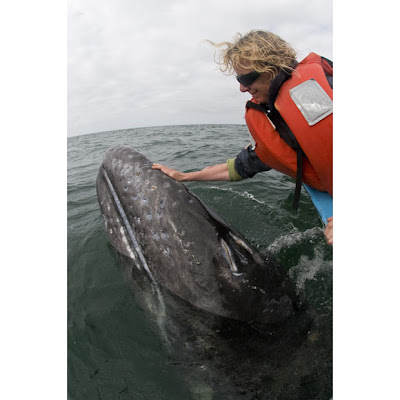
Tourists are greeted by a friendly grey whale whilst whale watching in San Ignacio Lagoon, Mexico

These wildlife enthusiasts were shown the impressive beasts by famous zoologist and BBC presenter Mark Carwardine who has been visiting the area for over 25-years.
Mark Carwardine said: "To have a huge, friendly whale willingly approach your boat and look you straight in the eye is without doubt one of the most extraordinary experiences on the planet."
"Sometimes they even let people rub their huge tongues or kiss them on the top of the head," said Mark, who co-presented the BBC 2 series Last Chance to See with Stephen Fry.

Mark is passionate about whale conservation and sees whale watching as an important way of increasing awareness and appreciation of these beautiful animals.

Among the many other species that come close are blue whales, and humpback whales, which often roll on their sides to look up at the passengers.

These whales begin their journey from the Bering Sea in the Arctic making it a 20,000km round trip, one of the longest migrations undertaken by any mammal. They set off down the Pacific coast in December and don't eat again until they return to their northern feeding grounds some five months later.


They love being stroked.....


and playful


They can just sense friendly humans


A great example of inter species bonding

This lady is in no danger at all

Lonely Penguin In Kiwi Land


The loneliest penguin in the world: 'Lost' Emperor swims on to beach in New Zealand after 4,000-mile wrong turn

Somewhere along the way, as it swam through the icy waters of Antarctica, a young emperor penguin took a wrong turn - and ended up in New Zealand.

The black and white bird came ashore on a beach in the south of the North Island nearly 4,000 miles away from its usual habitat.

There are two dozens colonies of the penguins in Antarctica, but this is the first time for 44 years a 'vagrant' bird has turned up in New Zealand.

A long way from home: An Emperor Penguin waddles along Peka Peka beach in New Zealand after becoming lost while swimming in the Southern Ocean


The creature's astonishing journey was witnessed by a woman walking her dog as the 2ft bird waddled out of the water in front of her.

Christine Wilton stumbled across the nautical wanderer on Peka Peka beach.

She said: 'It was out of this world to see it.

'It was this glistening white thing standing up on the sand and I thought I was seeing things.'

The tale of the lost penguin is similar to the 2006 children's film Happy Feet, in which a young penguin finds himself far from home during a voyage of discovery.

Which way to Antarctica? The 2ft bird is believed to have become lost while hunting for squid and krill among ice floes and its epic journey may have taken up to a month

Cows Not Moo-ved By Bear


This is the moment a herd of cows turns on a black bear after it attempted to make a meal of a grazing calf. The bear had spotted the calf separated from the group of cows on a 2,200 acre ranch in British Columbia, Canada. But it got more than it bargained for as the mother of the calf and two other cows charged the creature in a bloody battle lasting five minutes.


The enraged bovines took turns to stomp the bear with their heavy front feet, kick out with their back feet and crush it to the ground with their heads. The hungry bear bit one cow on the leg and left another with cuts and grazes on its face. But it was forced to give up under the assault and limped away with a loodied face. Photographer Wayne Ray captured the fight on his ranch near Fort Fraser. The area has had little rain in the last five months, leaving the bear with a scarcity of food.


 Udderly cross: Things aren't going well for the black bear as he is repeatedly kicked and butted to the ground

Mr Ray said: 'This small black bear was wandering around near a small group of cows and their calves in one of our pastures.'The cows were keeping an eye on the bear but they did not seem overly concerned. It was pacing back and forth and wandering in circles like he was confused or could not make up his mind what to do. 'It had lots of opportunities to go back into the trees or to go across the field and away from the cows and avoid a confrontation. 'But he made the mistake of turning toward the large blonde cow's calf. She charged at the bear and knocked it flying. Two other cows joined in immediately. 'The noise was incredible with the thundering of hooves, the vocalising of the cows and calves and the squealing of the bear.'


Bear-ly made it: The injured bear limps off after repeatedly going back to try and attack the calf

He added: 'The bear was young and either incredibly stupid or incredibly hungry, as he was able to get away from the cows three times and then turned and went back for more. 'When the bear finally gave up, he was bleeding from his nose and mouth and had a bit of a limp. He was probably suffering from several broken ribs and maybe some internal injuries. 'We thought the bear might not be able to survive the beating he took from the cows but we have not seen any ravens, bald eagles or other scavengers in the area.'

Trainer has lucky escape

A wildlife park worker had a lucky escape after slipping during a dangerous game of cat and mouse with a giant Bengal white tiger.

A crowd of onlookers held their breath as the park worker narrowly escaped a mauling after falling over while running from the fearsome beast.

The dramatic scene was captured during a daily 'tiger splash' event at the Out of Africa Wildlife Park, in Arizona, U.S.


  Park worker Jeff Harwell participates as the prey during a daily routine with the cats, where they chase an inflatable toy being held by him.

The tigers are usually so excited about capturing and popping the toy they do not harm the park workers.
The workers then jump into a pool with the tiger at the end of the game.

But this time Mr Harwell slipped over on the wet grass - and found himself between the two-year-old white tiger called Chalet and his inflatable toy. 

The tigers are supposed to chase and pop the inflatable toys, rather than the trainers - and sure enough Chalet's attention is diverted as the killer whale sails over his head
  Chalet reaches out a lethal paw to claw the toy as Mr Harwell quickly rolls to his feet, ready to flee if necessary

Thinking quickly, Mr Harwell managed to throw the toy into the pool, distracting the young tiger.


Chalet leapt in to the pool after the toy, as Mr Harwell scrambled to his feet.

Gasps of horror were heard from the audience.

But Mr Harwell - who was unharmed in the incident - continued to play with the tigers. 

The tigers who are not being trained to perform tricks at the park but are playing these games to tap into their natural instincts.

The World's Biggest Animals

Saturday, 24 November 2012

Here is a collection of the worlds biggest animals, from dogs to horses to cows, enjoy!


 World's Biggest Dog
Say hello to this gargantuan specimen named Hercules, purportedly the Guinness Record holder for World's Biggest Dog. Hercules is an English Mastiff and has a 38 inch neck and weighs 282 pounds.

With "paws the size of softballs", the three-year-old monster is far larger and heavier than his breed's standard 200lb. limit. Hercules owner Mr. Flynn says that Hercules weight is natural and not induced by a bizarre diet: "I fed him normal food and he just grew, and grew, and grew”.


World's Biggest Horse

 Radar, a Belgian draught horse, is the World’s Tallest Living Horse. This huge horse, at 6ft 71/2in from hoof to shoulder, is from Mount Pleasant, Texas. At 2,400lb, he has a giant appetite to match, putting away 20 gallons of water a day and 18lb of grain.

World’s Biggest Cow

 As big as a small elephant, Big Cow Chilli and he's described as a gentle giant. Chilli the giant bullock stands at 6ft 6ins and weighs well over a ton. Despite his grand stature, Chilli only grazes on grass during the day and enjoys the occasional swede as a treat.

World's Biggest Pig

 The Liaoning Provincial Agricultural Museum is appealing to the Guinness Book of Records to recognise a 900 kg (1984 pounds) pig which died on February 5 as the biggest pig ever. When the pig died it was 2.5 metres long, had a waistline of 2.23 metres and a tusk of 14.4 centimetres long. According to XU Changjin, a farmer of Wafangdian city, the pig was only 5 years old. He kept his pig in a good built sty and gave it quality food all its life.

World's Biggest Catfish

 At 646LB this Mekong Giant Catfish is the largest freshwater fish in the world. With nearly nine feet long (2.7 meters) and as big as a grizzly bear, this huge catfish caught in northern Thailand may be the largest freshwater fish ever recorded. Although there are many claims and rumours about the world’s largest freshwater specimens, especially from misguided anglers. However, in the eyes of scientist's the Mekong Giant Catfish has taken pole position with the recorded capture of this huge 646LB specimen by local fishermen in 2005. Many anglers over look the fact that some larger fish that can be caught in the worlds rivers, such as Sturgeon, migrate between river and sea, and therefore not considered to be freshwater species in the true sense of the word.

World's Tallest Dog

 Hercules might be the biggest dog in the world, but the tallest according to the Guinness World Records is Gibson, a Harlequin Great Dane, who is 42.2 inches. The 170-pound Dane is more than 7 feet tall, taller than most NBA basketball players.

World's Biggest Cat

 Jungle Island in Miami is home to a liger (a hybrid cross between a male lion and a female tiger) named Hercules, the largest non-obese liger. The liger is recognized by the Guiness Book of World Records as the largest cat on Earth, weighing in at 900 lbs.

World's Biggest Stingray ever caught

 It took 90 minutes to land, 13 men to heave it out of the water... and weighed 55 stone when they finally got it to the scales. So it's little wonder that when Ian Welch first hooked the record stingray, it almost pulled him into the river. The angler, from Aldershot, Hampshire, was fishing in Thailand when he landed the ray, which is the biggest freshwater fish to be caught with a rod, with over 7ft long and wide, with a tail of 10ft.

World's Biggest Shark ever caught

 
More likely to eat than be eaten, this giant whale shark was caught off the coast of China by hardcore fishermen who managed to harness the ten-metre, eight-tonne whopper. Whale sharks are the world's largest living fish, it is estimated that they can reach an 18 metre length. They live in warm water along the coast and open seas and spend most of their time near the surface.