Pages

Showing posts with label History. Show all posts

History of Cricket

Monday, 24 December 2012

The origins of cricket are obscure, and there are several theories on how it started. One is that shepherds used to play it - one would stand in front of the wicket gate to the sheep fold, and another would bowl a stone or something at him, and he would have to hit it with his crook, which was known as a cricket. Other theories are that it derives from a game called club-ball, or a game played in churchyards...

The first reference to cricket being played is thought to be in 1300, between Prince Edward and his friend Piers Gaveston and the first recorded match took place at Coxheath in Kent in 1646. The first match between counties on 29th June 1709, when Surrey played Kent at Dartford Brent.


The earliest known cricket photographs were taken in 1857, by Roger Fenton at the Artillery Ground, when the Royal Artillery played Hunsdonbury.

As well as shepherds' crooks, early bats were clubs and sticks. These gave way to long, thin battes, which looked a bit like straightened-out hockey sticks, because the ball was bowled under-arm, and the batters swung their bats like clubs!!

By the 18th century, the bat had developed into a longer, heavier, curved version of the one we know now, carved out of a single piece of wood.

Today's bat was invented around 1853, with the blade made of willow, and a cane handle, which is layered with strips of rubber, tied with twine, and covered with rubber to make a grip. The 'V' shaped extension of the handle into the blade is the splice. The early balls were stones and other missiles. Rather dangerous really, and not surprising that someone came up with an alternative! They're now made of cork, and covered with hand-stitched leather quarters dyed red.

The wicket - the stumps are the three posts. Originally there were two, and at one point, four. The size has varied too - in the 17th century, were up to two metres wide!! The bails are the two bits of wood on the top, and if they fall off, it's all over!!

Top 10 Countries That Disappeared In The 20th Century

Thursday, 20 December 2012


New nations seem to pop up with alarming regularity. At the start of the 20th century, there were only a few dozen independent sovereign states on the planet; today, there are nearly 200! Once a nation is established, they tend to stick around for awhile, so a nation disappearing is quite uncommon. It’s only occurred a handful of times in the last century. But when they do, they completely vanish off the face of the globe: government, flag, and all. Here then, in no particular order, are the top ten countries that had their moment in the sun but are, alas, no more.

10. East Germany, 1949-1990
Created from the Soviet controlled sector of Germany after the Second World War, East Germany was probably best known for its Wall and its tendency to shoot people who attempted to cross over it. Now, it’s one (over-reactionary) thing to shoot foreigners who are trying to enter your country illegally, but these were its own people!

Basically little more than a Soviet satellite state, the collapse of the notorious Wall and, with it, the demise of the old Soviet Union brought an end to this failed experiment in Communism, and it was integrated back into the rest of Germany in 1990. Because East Germany was so far behind the rest of Germany economically, however, its reintegration with the west almost bankrupted Germany. Today, however, things are swimming along nicely, thank you.
09. Czechoslovakia, 1918-1992
Forged from the remnants of the old Austro-Hungarian Empire, during its brief existence it was one of the few bright spots in Europe, managing to maintain one of the continent’s few working democracies prior to the Second World War. Betrayed by England and France in 1938 at Munich, by March of 1939 it had been completely occupied by Germany, and vanished off the map. Later it was occupied by the Soviets, who turned it into another vassal state of the old Soviet Union until that nation’s collapse in 1991. At that time, it finally reestablished itself as a vibrant democracy.

That should have been the end of the story, and probably would have been, had not the ethnic Slavs in the eastern half of the country demanded their own independent state, breaking Czechoslovakia in two in 1992. Today, it exists as the Czech Republic in the west, and the nation of Slovakia in the east, making Czechoslovakia no more. Though considering that the Czech Republic maintains one of the more vibrant economies in Europe, the far-less-well-off Slovakia maybe should have reconsidered.

08. Yugoslavia, 1918-1992
Like Czechoslovakia, Yugoslavia was a by-product of the breakup of the old Austro-Hungarian Empire in the aftermath of WWI. Basically made up of parts of Hungary and the original state of Serbia, it unfortunately did not follow Czechoslovakia’s more enlightened example. Instead, it maintained a somewhat-autocratic monarchy until the Nazis invaded the country in 1941, after which it became a German possession. With the collapse of the Nazis in 1945, Yugoslavia somehow managed to avoid Soviet occupation but not Communism, coming under the socialist dictatorship of Marshal Josip Tito, the leader of the partisan Army during WWII. It remained a nonaligned authoritarian socialist republic until 1992, when internal tensions and rival nationalism resulted in civil war. The country then split into six smaller nations (Slovenia, Croatia, Bosnia, Serbia, Macedonia, and Montenegro,) making it a textbook example of what happens when cultural, ethnic, and religious assimilation fails.


07. Austro-Hungary, 1867-1918
While all of the countries that found themselves on the losing side after the First World War suffered economically, and geographically to some degree, none lost more than the once-powerful Austro-Hungarian Empire, which found itself carved up like a Thanksgiving Day turkey in a homeless shelter. Out of the dissolution of the once-massive empire came the modern countries of Austria, Hungary, Czechoslovakia, and Yugoslavia, with parts of it going to Italy, Poland, and Romania.

So why did it break apart when its neighbor, Germany did not? Because it lacked a common identity and language, and was instead home to various ethnic and religious groups, most of whom had little to do with each other…to put it mildly. In effect, it suffered a large-scale version of what Yugoslavia suffered, when it saw itself similarly torn apart by nationalistic fervor. The difference was that Austro-Hungary was carved up by the victors in WWI, whereas Yugoslavia’s dissolution was internal and spontaneous.


06. Tibet, 1913-1951
While the land known as Tibet has been around for over a thousand years, it wasn’t until 1913 that it managed become an independent country. Under the peaceful tutelage of a chain of Dalai Lamas, it finally ran afoul of Communist China in 1951 and was occupied by Mao’s forces, thus ending its brief foray as a sovereign nation. China occupied an increasingly-tense Tibet throughout the ’50s until the country finally rebelled in 1959, which resulted in China’s annexation of the region and the dissolution of the Tibetan government. This finished the nation for good and turned it into a “region,” rather than a country. Today it remains a big tourist attraction for the Chinese government, though it still has issues with Beijing, by insisting it be granted its independence once again.


05. South Vietnam, 1955-1975
Created from the forceful expulsion of the French from Indo-China in 1954, someone decided it would be a good idea to split Vietnam in two, roughly at the 17th parallel, leaving a Communist north and a pseudo-democratic south. As with Korea before, it didn’t work any better in Vietnam, resulting in intermittent warfare between the two halves that ultimately dragged the United States into a conflict (again with the Korea comparisons,) that was to result in one of the most draining and costly wars in American history. Finally hounded out of the country by dissent at home, America left South Vietnam to fend for itself in 1973, which it did for only two more years, before the Soviet-backed North finally rolled over the country, bringing an end to South Vietnam and renaming Saigon—its capitol—Ho Chi Minh City. It’s been a socialist utopia ever since.


04. United Arab Republic, 1958-1971
In yet another ill-fated attempt to bring unity to the Arab world, Egypt’s fiery socialist president, Gamel Abdel Nasser, thought it would be a splendid idea to unite with his distant neighbor, Syria, in an alliance that would effectively surround their sworn enemy, Israel, and make them a regional superpower. Thus was created the short-lived U.A.R., an experiment that was doomed to failure almost from the start. Being several hundred miles apart made creating a central government almost impossible, while Syria and Egypt never could quite agree on what constituted national priorities.

The problem might have been rectified had Syria and Egypt managed to link their halves together by destroying Israel, but that nasty Six Days War came along in 1967, dashing their plans for a common border, and handing both halves of the U.A.R. a defeat of biblical proportions. After that the merger’s days were numbered, and finally came to an anti-climactic end with the death of Nasser in 1970. Without the charismatic Egyptian President around to hold the fragile alliance together, the U.A.R. quickly dissolved, restoring the nations of Egypt and Syria once again.


03. Ottoman Empire, 1299-1922
One of the great empires in history, the Ottoman Empire finally came to an end in November of 1922, after a pretty respectable run of over six hundred years. Once extending from Morocco to the Persian Gulf, and from Sudan to as far north as Hungary, its demise was a slow process of dissolution over many centuries until, by the dawn of the 20th century, it was but a shadow of its former self.

But even then, it was still the main power broker in the Middle East and North Africa, and might still be that way today had it not chosen to ally itself with the losing side in World War I. It saw itself dismantled in the aftermath, with the biggest chunk of it (Egypt, Sudan, and Palestine) going to England. By 1922 it had outlived its usefulness, and finally died when the Turks won their war of independence in 1922 and abolished the Sultanate, creating the modern-day nation of Turkey in the process. Still, you’ve got to give it credit for making such an impressive run before giving up the ghost.


02. Sikkim, 8th century CE-1975
What? You’ve never heard of the place? What rock have you been hiding under? Seriously, it’s not likely you would have heard of tiny, land-locked Sikkim, nestled securely in the Himalayan Mountains between India and Tibet…er, China. About the size of a hot dog stand, it was basically one of those little-known, and largely forgotten, little monarchies that managed to hold on into the twentieth century before it finally realized it had no particularly good reason for being independent, and decided to merge with modern India in 1975.

Its coolest claim to fame? Though just a little bigger than Rhode Island, it has no fewer than eleven official languages, which must play havoc with traffic signs—assuming, that is, that they have any roads.


01. Union of Soviet Socialist Republic (Soviet Union), 1922-1991
What would the 20th century have been without the good ‘ol USSR to stir things up? One of the truly scary counties on the planet until its anticlimactic collapse in 1991, for seven decades it stood as the bulwark of Marxist Stalinism, with all the misfortune that brought with it. It was created in the chaotic aftermath of the breakup of Imperial Russia after WWI, and both survived and thrived despite inept economic policies and brutal leadership. The USSR actually managed to beat the Nazis when no one thought that Hitler could be stopped, enslaved eastern Europe for over forty years, instigated the Korean War in 1950, and very nearly got into a shooting war with the United States over Cuba in 1962, making its tenor on the world stage nothing if not eventful.

Finally coming apart in the aftermath of the fall of the Berlin wall in 1989, and the subsequent collapse of Communism in eastern Europe, it broke into no fewer than fifteen sovereign countries, creating the largest new block of countries since the breakup of the Austro-Hungarian Empire in 1918. What followed was the pseudo-democratic Republic of Russia, though it still retains much of the autocratic air it has always been famous for.

Jeff Danelek is a Denver, Colorado author who writes on many subjects having to do with history, politics, the paranormal, spirituality and religion. Via — Link

The Venice Historical Regatta

Monday, 6 September 2010

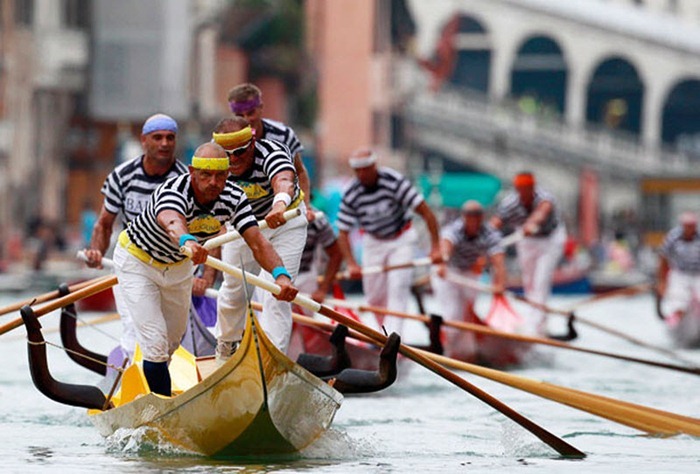
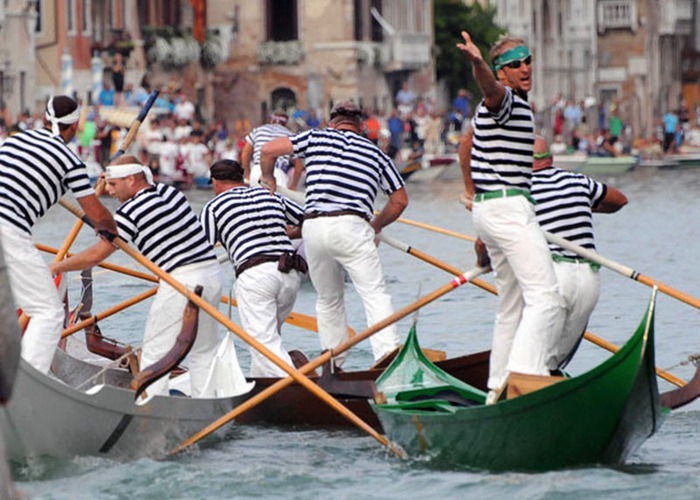
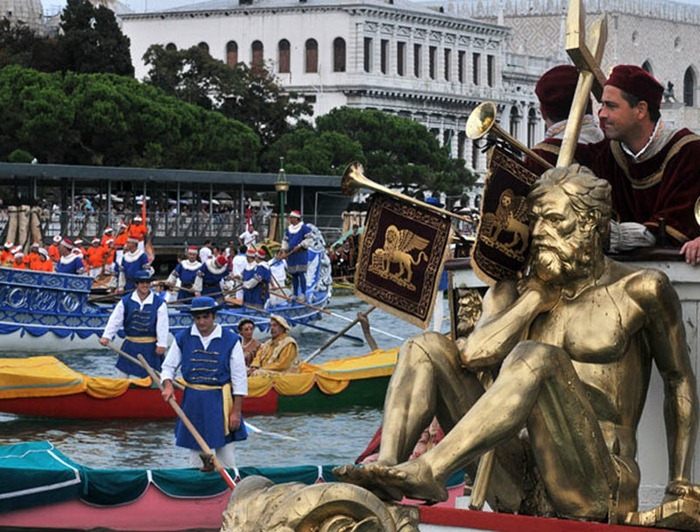
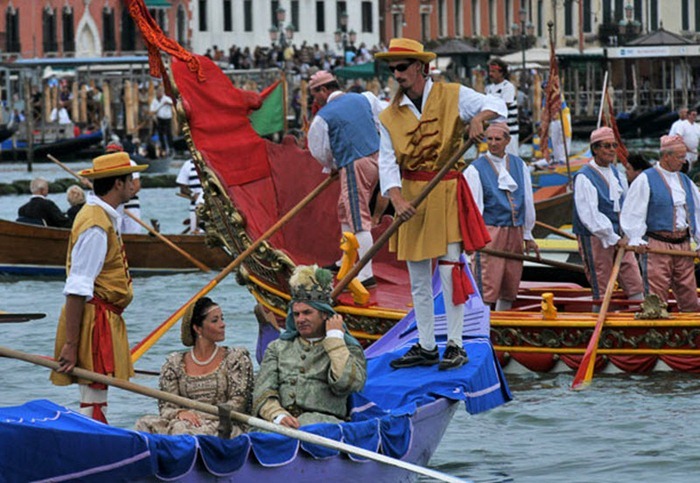
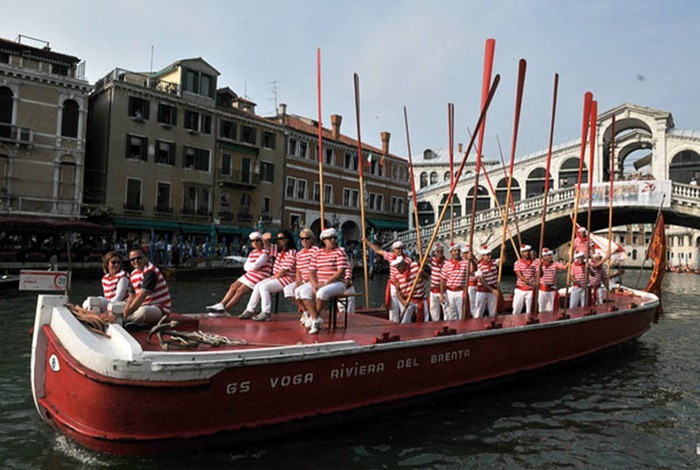
Every year, on the first Sunday of September, the Historical Regatta is held in Venice. Hundreds of Venetians pile into the long boats that have plied the city's canals for centuries for the 'Regata Storica' (Historical Regatta), a historical procession that commemorates the welcome given to Caterina Cornaro, wife of the King of Cyprus, in 1489 after she renounced her throne in favour of Venice.
venice-regatta (1)
The spectacular historical water pageant is driven by gondoliers wearing historic costume carrying the Doge, the Doge’s wife and all the highest ranking Venetian officials up the Grand Canal in a brightly coloured parade. This is followed by four separate boat races. The winners are awarded flags in place of medals. Until few years ago, together with the symbolic prizes, there were also some kind of awards; the most famous of them was a little living pig, that would parade on a gondola of its own. The pig ceremony has been abolished since few years ago after protests by some animal protection organizations. PETA is always ruining the fun.

venice-regatta (2)
venice-regatta (3)
venice-regatta (4)
venice-regatta (5)
venice-regatta (6)
venice-regatta (7)
venice-regatta (8)
venice-regatta (9)
venice-regatta (10)
venice-regatta (11)
venice-regatta (12)
venice-regatta (13)

Top 10 Greatest Selling Albums in Music History

Sunday, 5 September 2010


In order to gain a spot on the list of
the Top 10 greatest selling albums in history a band needs to be
internationally recognized and extremely popular all

over they world. Here are the 10 most financially successful albums in musical history.


10. Saturday Night Fever Soundtrack - Bee Gees


Worldwide Sales - 40 Million Copies +


The Saturday Night Fever soundtrack was released in November of 1977. The


record helped to revive the phenomenon of disco in the U.S. and started a


national trend. It is composed and performed primarily by The Bee Gees and


features numerous hit singles, including Stayin’ Alive, Night Fever, and How


Deep is Your Love. The record went on to win the Grammy Award for Album


of the Year. The Saturday Night Fever soundtrack has become the third


highest selling soundtrack of all time.


9. Backstreet Boys - Millennium


Worldwide Sales - 40 Million Copies +


Millennium is the second studio album by The Backstreet Boys. It was released


on May 18, 1999 and was the group’s first record to be released in both the


U.S. and internationally at the same time. The album holds the U.S. record for


yearly shipments, selling 11 million units in 1999. It spawned four hit singles,


including I Want it That Way, Show Me the Meaning of Being Lonely, and


Larger Than Life. Millennium set records for the most albums sold in its debut


week and also most records sold internationally in one week with 2.2 million.


It was certified platinum in over 45 different countries.


8. Andrew Lloyd Webber - The Phantom of the Opera


Worldwide Sales - 40 Million Copies +


The Phantom of the Opera is a musical by Andrew Lloyd Webber, based on the


French novel Le Fantôme de l'Opéra by Gaston Leroux. The music was


composed by Webber, with lyrics by Charles Hart and additional lyrics by


Richard Stilgoe. The musical focuses on a beautiful soprano, Christine Daaé,


who becomes the obsession of a mysterious and disfigured musical


mastermind, known as The Phantom of the Opera. The show opened in


London's West End in 1986. It is the second longest running musical in


England’s West End and the longest-running Broadway musical. According to


sales numbers The Phantom of the Opera is the most successful entertainment


project in history, amassing an incredible $5 billion dollars worldwide.


7. The Bodyguard Soundtrack - Whitney Houston


Worldwide Sales - 42 Million Copies +


The Bodyguard soundtrack was released on November 17, 1992 and


featured six songs from Whitney Houston, as well as tracks from various


recording artists. Whitney Houston’s cover of I Will Always Love You was an


instant #1 single. Some other artists featured on the record include Kenny G,


Lisa Stransfield, and Joe Cocker. It became the first album to sell more than a


million copies in a single week. It also received the Grammy Award for Album


of the Year.


6. Dirty Dancing Soundtrack


Worldwide Sales - 42 Million Copies +


The Dirty Dancing soundtrack was released on August 21, 1987. The album


had many hit singles including Hungry Eyes by Eric Carmen, Be My Baby by


The Ronettes, and The Time of My Life by Bill Medley and Jennifer Warnes. It


spent 18 weeks on the top of U.S. charts and inspired a follow-up album


entitled More Dirty Dancing. The album still re-enters the Irish charts on


occasion. It has spent over 230 weeks in the Top 30 in Ireland.


5. Eagles - Their Greatest Hits (1971-1975)


Worldwide Sales - 42 Million Copies + 


Their Greatest Hits is the fifth album by the rock band the Eagles. It includes a


compilation of singles and was released February 17, 1976. The years in the


album's title, 1971 to 1975, refer to the existence of the band itself, not the


release dates of the tracks. It includes ten classic hits, including Take it Easy,


Lyin’ Eyes, Already Gone, Desperado, and Peaceful Easy Feeling. The


Eagles music greatly influenced the genre of country-rock and paved the way


for numerous bands in the 1970’s. Their Greatest Hits has sold 29 million


copies in the United States, making it the best-selling album of all time in the


U.S.


4. Pink Floyd - The Dark Side of the Moon


Worldwide Sales - 43 Million Copies +


The Dark Side of the Moon is the 6th studio album by English rock group Pink


Floyd. It was released in March of 1973. The record was an instant success


and spawned the singles, Money and Time. The refracting prism cover art is


one of the most recognizable in rock music history. Pink Floyd used some of


the most advanced recording techniques of the time, including multitrack


recording and tape loops. Analogue synthesizers were also given prominence


in many tracks. Founding member Syd Barrett had left the band in 1968, but is


credited as the author of the entire album's lyrics.


3. Meat Loaf - Bat out of Hell


Worldwide Sales - 43 Million Copies +


Bat out of Hell is the 2nd studio album released by Meat Loaf. It was dropped


on October 21, 1977. The main writer on the records production was Jim


Steinman. It was developed from a musical, Neverland, which was a sci-fi


update of Peter Pan, which Steinman wrote for a workshop performed at the


Kennedy Center Music Theatre Lab in 1977. Response to the album was


slow. Australia and England were the first to gain an enthusiastic response


after some popular music video were releases. Ultimately, the record stayed


on the United Kingdom charts for 474 weeks. It continues to sell around


200,000 units each year. The original release only had seven tracks on it,


including classics Bat out of Hell, All Revved Up with No Place to Go, and Two


out of Three Ain’t Bad.


2. AC/DC - Back in Black


Worldwide Sales - 49 Million Copies +


Back in Black is the 7th studio album by Australian hard rock band AC/DC. It


was released on July 25, 1980. Back in Black was the first AC/DC album


recorded without former lead singer Bon Scott, who had died at the age of 33.


It is the best-selling album ever released by a band and has sold 22 million


units in the U.S. alone. The album includes some of the group’s biggest hits


including Hells Bells, You Shook Me All Night Long, and the title track Back in


Black. According to lead guitarist Angus Young the album's all-black cover was


a sign of mourning for Scott. This record is widely considered the best hard


rock album ever created.


1. Michael Jackson - Thriller


Worldwide Sales - 110 Million Copies +


Thriller was Michael’s sixth studio album and was released on November 30,


1982 by Epic Records. The production budget for the record was $750,000


and Jackson wrote four of the tracks on the album. At its peak, the album was


selling a million copies a week worldwide. Seven of the album's nine songs


were released as singles, and all reached the top 10 on the Billboard Hot 100.


The album won a record-breaking eight Grammy Awards in 1984. With Michael


Jackson’s death this year Thriller has sold millions more copies around the


world.


credited to www.listzblog.com

Amazing facts-Cannibalism

Friday, 3 September 2010

Cannibalism is as old as mankind and we certainly weren’t the first to come up with the idea. Animals have been eating members of their own species since the dawn of time and think nothing of it. To them it’s perfectly natural. Many species of arachnid, for example, instinctively begin to chow down on their mothers as soon as they are born and some mammals have been known to do the same thing. In fact, in some cases mammalian mothers will eat their own offspring if they feel the conditions needed to rear offspring have not been met. Ever seen a hamster do this? It’s pretty disturbing.

Of course, the introduction of civilization, the very thing that separates us from the animals, makes it impractical and morally objectionable to kill and eat your kinsmen. When living in a group structure it is much better to let your friends and family live so they can help you carry that massive mammoth carcass back home. But what if your intended victim is not a member of your tribe? By making a meal of a rival tribesman you not only rid yourself of a troublesome neighbor, you also get yourself a family sized bucket of tasty man flesh as a special treat for the kids. This is one widely accepted answer to the question of where all those pesky Neanderthals went. That’s right, we ate them (or some of them at least – the rest probably ate each other).

Here are some examples of cannibalistic societies in recorded history:


The Carib
The Carib people of the Lesser Antilles not only had the entire Caribbean Sea named after them; their name is also the origin of the word cannibal. Christopher Columbus was the first to report cannibalism among the Carib, whom he referred to as the Caniba (a mispronunciation of ‘Karibna’, the Carib word for ‘person’). Following this many Europeans formed the belief that the Carib practiced general cannibalism but this was not true, the Carib practiced ritual cannibalism and only ever against their enemies.

Any conquistador to stumble across a society of cannibals would have been utterly thrilled. At the time it was considered a Christian’s duty to punish and subjugate any society known to practice cannibalism. This led to many tribal cultures in the Africa and the Americas being falsely accused of cannibalism and may have precipitated the slave trade.

amazing-facts
The Aztec
The Aztec were without a doubt the most brutal society in pre-Columbian America. They made thousands of human sacrifices each year, ceremonially slaughtering their victims in a variety of grim ways. Typically, victims had their beating hearts torn out but being burned alive was also quite common. So what did the Aztecs do with the bodies after the party was over? While there is no academic consensus on whether or not the Aztecs practiced cannibalism it stands to reason that they did. Cannibalism, while not necessarily a cultural norm, was not uncommon in pre-Columbian societies and many scholars argue that the Aztecs would have thought little of rummaging through the temple bins for a snack. Others theories that human flesh would have been a delicacy eaten only by the aristocratic elite. The lack of animal proteins in the Aztec diet would have made human flesh a healthy and desirable treat, especially considering the novelty value.
amazing-facts
The Native Americans
There is evidence to suggest that many Native American peoples, including the Sioux, the Cree, the Comanche and even the Iroquois, may have once practiced ritualistic cannibalism. Of course, this is a highly charged and highly political debate. Many argue that the accusation of cannibalism is an attempt to depict Native Americans as brutal and uncivilized peoples, thus justifying their subjugation. However, some argue the opposite, saying that Native American cannibalism has been denied or even covered up by some historians in the name of political correctness. Whatever the truth, it would seem that cannibalism was once practiced by at least some Native American cultures, particularly those of Texas, New Mexico, and Arizona. The now extinct Karankawa of Texas are a prime example. In 1768 a Spanish priest witnessed and recorded a Karankawa ritual in which a captive was tied to a stake. The Karankawa danced around the man, occasionally slicing off a piece of his flesh to be roasted and eaten in front of him.
amazing-facts
Africa

While no single society in Africa can be cannibalistic, the practice of cannibalism in Africa throughout history has been frequent and widespread. Even today there is thought to be an underground trade in human body parts. Some believe that eating certain human organs and body parts will have a magical healing effect and some witchdoctors are thought to run black market operations, actively harvesting, proscribing and selling bits of other people as supposed ‘natural treatments’. As a result, thousands of people across Africa go missing each year after falling prey to the collection gangs. Most cruel of all is the fact that many victims are not killed but have parts of their bodies removed whilst alive. Sickeningly a human penis can be sold as a cure for impotence but there is a market for everything from a victim’s fingers to their lips.

Cannibalism has also been reported in several recent African conflicts, including the Second Congo War and the civil wars in Liberia and Sierra Leone. It is usually directed against social or racial groups that are thought to be vulnerable, such as the Congolese Pygmies.
amazing-facts
Fiji
Cannibalism seems to have once been widespread in many Polynesian and Melanesian cultures. For example, Fiji was once known as the cannibal isles. One Fijian tribal chief claimed to have eaten 875 people and boasted of his achievement.

The native inhabitants of the Marquesas Islands in French Polynesia were also thought to be cannibals. When a waling ship capsized near the islands in 1820 the captain decided to lead the survivors 3000 miles upwind to Chile rather than risk taking on the cannibals. Ironically, the survivors themselves later resorted to cannibalism as a means of survival.

amazing-facts
The Korowai
The Korowai of Papua, Indonesia may be the only tribe left in the world to practice ritual cannibalism. It is said that they kill and eat members of their tribe that have been convicted of witchcraft, although this may just be a ploy to attract tourists. Apparently the brain is most tasty part of the victim’s body and is eaten raw while still warm. Korowai houses are built high on stilts. It is thought that this design evolved through a need for protection, owing to the once rampant practice of cannibalism on the island. Members of the Fore tribe, who live on the opposite side of the island to the Korowai in what is now Papua New Guinea, are thought to have contracted the degenerative brain disorder Kuru (also known as laughing sickness) through the ritual consumption of their own dead tribesmen.
amazing-facts
The Maori
One of the most well documented instances of cannibalism involves the Maori people of New Zealand. Cannibalism has been a part of Maori warfare since time immemorial and they didn’t stop at killing and eating their rival tribesmen. When the crew of a British ship, the Boyd, were accused of unjustly flogging the son of a Maori chieftain, his father’s warriors took revenge by killing and eating 66 of the ship’s passengers and crew. The event became known as the ‘Boyd Massacre’. The Maori also cannibalized European settlers in the ensuing wars and rebellions against the British Empire, as recently as 1869.

Of course, the Maori kicked the habit long ago and now live a healthy flesh-free lifestyle. The same can also be said of all the cultures on this list, with the possible exception of the Korowai. But it cannot be said that the archaic act of cannibalism has completely disappeared; every now and then it rears its ugly, flesh-chewing head to remind us of our gruesome and barbaric past. Sometimes this occurs in extreme survival situation (which can perhaps be forgiven) but it can also take the form of a single crazed lunatic.
amazing-facts
Jean-Bédel Bokassa
The self declared Emperor of the Central African Republic, Jean-Bedel Bokassa, has been tried, but never convicted, of cannibalism. In 1979, when a number of school children protested against the introduction of new, mandatory school uniforms Emperor Bokassa gobbled the naughty children up. Some one hundred school children were massacred and, while Bokassa clearly could not have eaten all of them, he is thought to have beaten many of them to death himself. Bokassa’s Ugandan contemporary, Idi Amin, is also rumored to have eaten his enemies.

amazing-facts
Dorangel Vargas
Dorangal Vargas, otherwise known as the ‘Hannibal Lecter of the Andes’, killed and ate at-least ten men while homeless and living in a park in San Cristobal, Venesuala. Vargas used the park as a hunting ground for two years before being arrested in 1999, after which he has spoken openly about his crimes. “I make a very tasty stew out of the tongue” Vargo told reporters “and I use the eyes to make a healthy and nutritious soup.”
amazing-facts